

 English
 Español
 Português
-
+86-15669283739
-

-
Home / News / Industry News / Automatic Pet Food Feeder Buying Guide: Portion Control, Capacity, and Sourcing
Automatic Pet Food Feeder Buying Guide: Portion Control, Capacity, and Sourcing
2026-09-03
Content
- 1 How an Automatic Pet Food Feeder Works—and Where Designs Differ
- 2 Specifications That Separate Reliable Feeders from Cheap Ones
- 3 Matching the Feeder to Cats, Dogs, and Multi-Pet Homes
- 4 What Wholesale Buyers Should Verify Before Ordering
- 5 Daily Habits That Keep a Feeder Working for Years
- 6 The Bottom Line
Most pets do not need reminding when it is dinnertime—they need someone to enforce it. If your cat wakes you at 5:30 a.m. by pawing your face, or your dog gets a double portion because two family members each fed him "just in case," an automatic pet food feeder solves a scheduling problem, not an affection problem. The short version: choose a feeder that matches your pet's portion size, your absence pattern, and the shape of your kibble, and it will keep meals consistent for years. Buy on hopper capacity alone and you will likely replace it within a season. This guide explains how the main feeder designs differ, which specifications separate reliable units from frustrating ones, and what wholesale buyers should confirm before placing an order.
How an Automatic Pet Food Feeder Works—and Where Designs Differ
Nearly every feeder on the shelf belongs to one of three families, and the differences matter more than the feature lists suggest.
Gravity feeders are the simplest: a storage hopper refills the bowl as your pet eats. They never run out mid-day, but they offer no scheduling and no portion control, which makes them a poor fit for cats and for food-motivated dogs that will simply eat until the hopper is empty. Programmable hopper feeders fix that with a motor-driven auger or sliding gate that releases a measured portion at set times, typically four to six meals per day, with portions adjustable down to about 1/8 cup. Smart feeders add app-based scheduling, cameras, and meal notifications, and some models use RFID or microchip recognition so that only the right pet in a multi-pet household can reach the food.
Bowl layout deserves attention too. Single-bowl units suit straightforward kibble schedules, while dual-bowl designs keep food and water in one station or hold two foods side by side. That second bowl is practical for cats that prefer their water away from their food, and for households that serve dry kibble with a wet topper on a fixed schedule.
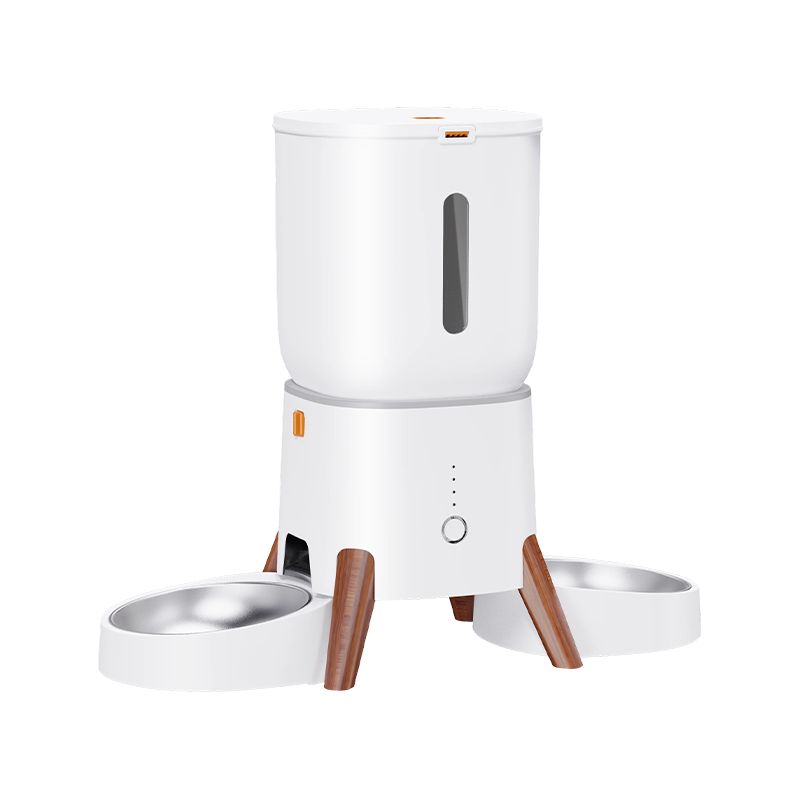 One-Piece Dual-Bowl Smart Pet Feeder with Stainless Steel BowlsA dual-bowl feeder with 304 stainless steel bowls, 5L capacity, timed dispensing, and Tuya app control. It fits the discussion of dual-bowl layouts that keep food and water in one convenient station.View Product →
If you are torn between the simple refill approach and timed dispensing, it is worth reading a dedicated automatic feeder vs. gravity feeder comparison before deciding. The right answer depends almost entirely on whether your pet self-regulates, and that single trait should drive the decision more than any feature list.
Specifications That Separate Reliable Feeders from Cheap Ones
Three failure points account for most returns and complaints: jammed augers, drifted portions, and lost power. Check each one before you buy a single unit or order a container of them.
Portion accuracy and kibble tolerance
Well-built auger feeders dispense within roughly 10 percent of the programmed amount, either over or under, while cheaper units drift further as oily kibble coats the mechanism. If your pet is on a weight-management plan, run one test week and weigh a few dispensed portions on a kitchen scale—the result tells you more than any marketing claim. Also confirm the maximum kibble size in the manual. Most augers handle pieces up to about 12 to 15 mm in diameter, and oversized or irregularly shaped pieces are the number-one cause of jams.
Capacity, power, and noise
A 3-liter hopper holds roughly 1.2 to 1.5 kg of kibble, which is about two weeks of food for one cat, though fat oxidation means dry food stays freshest in smaller batches. Dogs need larger hoppers and sturdier construction—some dogs learn to knock units over or pry lids open within days. On power, insist on dual supply: a mains adapter plus battery backup, so a blackout does not erase the schedule. Noise matters more than buyers expect, because a loud motor can teach a nervous cat to fear the very machine that feeds it. Run the first few cycles while you are home and watch the reaction.
| Feeder type | How food is delivered | Scheduling control | Best fit | Main limitation |
|---|---|---|---|---|
| Gravity | Hopper refills bowl as the pet eats | None | Self-regulating dogs needing a buffer | No portion control; overeating risk |
| Programmable hopper | Auger or gate drops measured dry kibble | 4 to 6 meals per day | Cats and dogs on dry food | Kibble size limits; dry food only |
| Timed dish | Rotating tray with sealed compartments | 5 to 6 fixed meals | Wet food over short absences | Limited cooling time for wet or raw food |
| Smart app feeder | Auger plus app and camera control | Fully remote, per meal | Busy owners tracking portions | Needs Wi-Fi and more power |
| Microchip feeder | Lid opens only for the tagged pet | Access control, not timing | Prescription diets in multi-pet homes | Does not schedule meals by itself |
Matching the Feeder to Cats, Dogs, and Multi-Pet Homes
Cats do best with small, frequent portions, so look for fine granularity at the low end of the portion range and a quiet motor. Dogs need volume and tamper resistance: a locking lid, an anti-tip base, and a hopper sized for their full daily ration. In multi-pet households, a microchip feeder prevents the classic problem of one animal finishing another's prescription diet.
Wet food changes the calculus. Dish-style feeders with sealed, ice-packed compartments keep canned food safe for roughly half a day to a day, so they cover a long workday but not a weekend. For anything longer with wet-fed pets, you still need a sitter or a planned transition to dry food.
One more feature earns its keep the first time your evening meeting runs late: remote adjustment. Triggering a meal or shifting a portion from an app—or from a handheld remote at home—means the feeding plan bends to real life instead of the other way around.
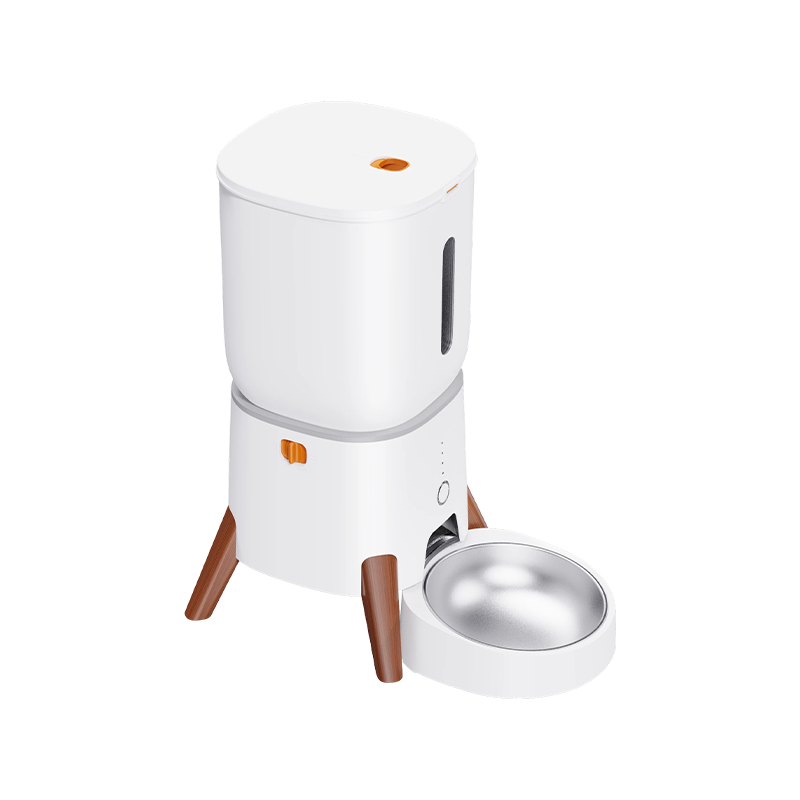 Remote-Controlled Automatic Pet Feeder with App ControlThis feeder offers app-based remote feeding adjustments, a 5L hopper, and a stainless steel bowl design, making it a practical example when a late schedule calls for triggering or shifting meals remotely.View Product →
What Wholesale Buyers Should Verify Before Ordering
For distributors and brand owners, the specification sheet is only the starting point. Before committing to a production order, put these five questions to any candidate supplier:
- Which food-contact plastics are used in the hopper and bowl, and can the supplier provide FDA or LFGB test reports for them?
- What is the tested service life of the auger motor, and how does the mechanism behave when kibble is oversized or dusty?
- Are the molds and injection molding handled in-house? A supplier that owns its tooling can adjust hopper geometry, correct fit-and-finish issues, and refine dispenser tolerances without waiting on a third party.
- How is retail packaging drop-tested, given that feeders ship with hoppers, lids, and electronics pre-assembled?
- Which certificates can be supplied for your target markets, and can you audit or tour the factory before the first order?
Sourcing from a pet products manufacturer with in-house mold and injection facilities also shortens the path from sample approval to volume production, which matters when a seasonal promotion depends on fixed delivery dates. Tooling control, in practice, is what turns a good sample into a consistent shipment.
Daily Habits That Keep a Feeder Working for Years
Feeders fail from neglect far more often than from defects. Kibble fat leaves a slick film near the dispensing outlet, and that film is what turns a smooth auger into a jam machine. Wash the hopper, bowl, and outlet parts in warm soapy water at least weekly, and dry them fully before refilling. Replace the desiccant in the lid on schedule, finish old kibble before topping up with a new bag, and glance at the food level and battery indicator before every trip. Five minutes of maintenance per week protects a purchase that is supposed to run unattended for years.
The Bottom Line
An automatic pet food feeder pays for itself the first month it removes early-morning wake-ups, skipped lunches, and portion arguments. Choose programmable dispensing over gravity refills when portion control matters, verify accuracy and kibble tolerance in the specifications, insist on battery backup, and match the bowl layout to how your household actually feeds. Buyers ordering at volume should add one more step: confirm the supplier controls its own tooling and can document food-contact compliance. Do those things and the feeder becomes what it should be—boringly dependable, twice a day, every day.

Contact Information
No. 2, Macaotou Road, Mazhu Town, Yuyao City, Zhejiang Province, China
+86-15669283739
Copyright © Ningbo Meace Pet Products Co., Ltd. Rights Reserved
