

 English
 Español
 Português

-
+86-15669283739
-

-
Home / News / Industry News / Automatic Pet Food Feeder Buying Guide: Portion Control, Capacity and Power Backup
Automatic Pet Food Feeder Buying Guide: Portion Control, Capacity and Power Backup
2026-11-19
Content
At 6:40 a.m., a feeder that drops 12 grams instead of the programmed 10 is not a small error. For a 4 kg cat on a controlled diet, a 20% overshoot twice a day adds roughly 80 extra grams per week, enough to blur a weight-management plan. The conclusion first: buy an automatic pet food feeder for reliable portion control, power backup, and easy cleaning. App features and remote control matter only after those basics are proven. The rest of this guide explains what to measure, where feeders fail, and how to compare models without paying for features that do not affect daily feeding.
Portion Control Comes Before Connectivity
An automatic feeder is a dispensing machine, not a smart device with a hopper attached. The critical specification is portion repeatability: the weight or volume dispensed each time the schedule triggers. Ask for a tolerance statement. A practical target for dry kibble is within plus or minus 5% of the set portion after the first few dispenses, with no cumulative drift across 20 cycles. Test three portion sizes, small, medium, and large, because a mechanism that is accurate at 10 g can overfill at 40 g.
Use a kitchen scale, not the app's reported portion. Run 10 consecutive dispenses, record each weight, and check the spread. If the spread is wider than the label suggests, the feeder will be hard to use for weight control. Also check the minimum portion. A feeder that cannot reliably dispense below 10 g is unsuitable for small cats or toy breeds on measured diets. For buyers, this is a specification issue, not a software issue. A well-designed app cannot correct an outlet that drops inconsistent volumes.
Capacity and Hopper Design: Match the Feed, Not the Photo
Capacity is usually quoted in liters, but feeding plans are written in grams. The conversion depends on kibble density, shape, and how much the hopper can hold without bridging. A 3 L hopper may hold roughly 1.5 kg of typical dry kibble, but treat that as an estimate and verify with the actual food. The chart below shows how daily portion changes the number of days between refills at that estimate.
Example: days from a 3 L hopper at about 1.5 kg kibble
50 g/day
30 days
75 g/day
20 days
100 g/day
15 days
For a single cat eating 50 g per day, a 3 L hopper is a practical weekly-plus reserve. For a 35 kg dog eating 300 g per day, the same hopper is a short refill cycle, and a larger hopper or a feeder with a sealed extension is more appropriate. Hopper shape matters as much as volume. Narrow throats and sharp corners can cause bridging with flat or large kibble. Ask whether the outlet is designed for the kibble size you sell or feed. If you are comparing powered dispensing with a simple gravity design, this automatic versus gravity feeder comparison is a useful starting point.
Power, Backup, and the Real Cost of a Missed Meal
Power design is where low-cost feeders often hide risk. A feeder with only USB power and no battery backup will stop at the first outage or loose cable. For cats and small dogs, a missed meal is inconvenient. For dogs on medication or senior pets on a strict schedule, it is a health and behavior problem. Look for two independent power paths: mains or USB adapter plus batteries, or a rechargeable battery that can run the schedule for a stated number of days.
Check whether the feeder keeps its program after power loss. If it resets to a default schedule, the backup is incomplete. Also check the low-battery warning. A warning that appears only when the battery is nearly empty is less useful than one that gives several days of notice. For remote feeding, test the app's offline behavior: can you still dispense manually at the feeder when Wi-Fi is down? A feeder that depends on the cloud for every meal is a single point of failure.
Dual-Bowl and Remote Models: Where They Fit
Dual-bowl feeders are not just for two pets. They are useful when one pet needs dry food and water in the same station, or when a household wants to split a daily ration into two bowls without buying two machines. The trade-off is that the second bowl often has less control. Check whether both bowls are portioned or whether one is a simple gravity water or food side. For two cats on different diets, separate feeders are usually safer than a shared dual-bowl unit because one pet can eat the other's ration. A one-piece dual-bowl smart feeder can still be a good fit for a single pet on a split feeding plan or for a small household that wants a compact station.
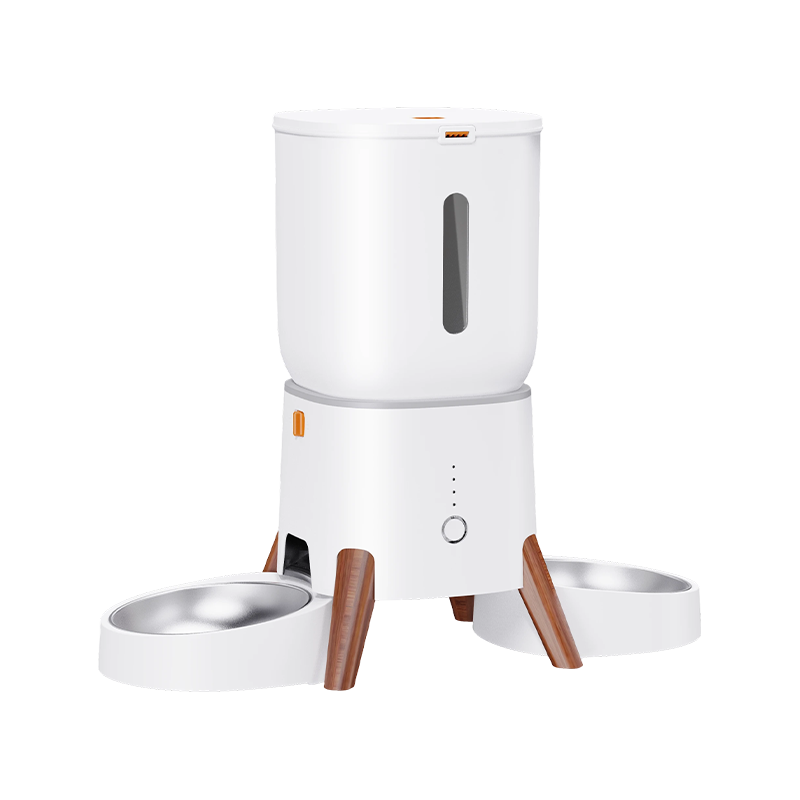 EZ3003 Double Bowl Smart Automatic Pet FeederFor a compact dual-bowl station, this automatic feeder offers timed portions, mixed-food compartments, stainless-steel bowls, and Tuya app control.View Product →
Remote-controlled models suit owners who travel, work irregular hours, or need to trigger an extra meal without changing the schedule. The key question is not whether an app exists but what happens when the app does not. Look for manual feed buttons on the device, a clear portion history, and a schedule that is stored locally. If the remote control only works on the same Wi-Fi network, it is a convenience feature, not a travel solution. If it works over the internet, check the latency and whether commands queue reliably after a brief outage. A remote feeder should reduce anxiety, not add a second system to monitor.
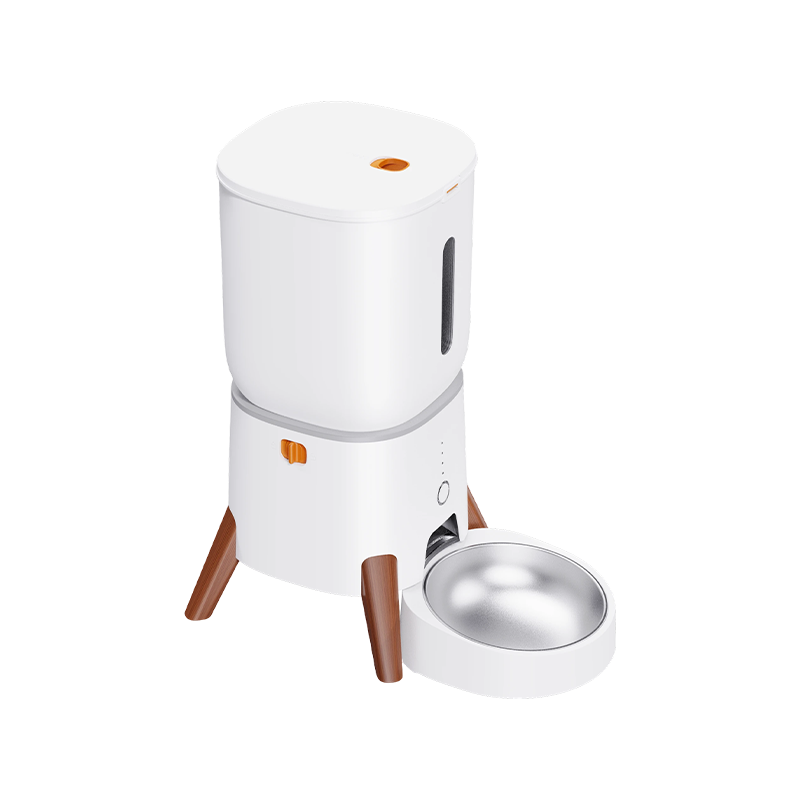 EZ3003 Single Bowl Remote-Controlled Automatic Pet FeederA 5 L remote-controlled feeder with app scheduling when powered, battery-mode timed feeding, and stainless-steel construction for busy owners.View Product →
Cleaning, Kibble Compatibility, and Mechanical Risk
Food-contact parts should be removable without tools. The hopper, auger or impeller, outlet, and bowl are the parts that collect oils and crumbs. If the hopper cannot be fully emptied and washed, stale food will build up at the bottom, and the feeder will become a hygiene problem before it becomes a mechanical one. Check the material statement for food-contact plastics and whether the bowl is dishwasher safe.
Kibble compatibility is the second filter. Very small kibble can leak through gaps; very large or flat kibble can jam the auger. A feeder rated for 5 to 12 mm kibble is not interchangeable with one rated for 12 to 20 mm. Test with the actual food, not rice or treats. Mechanical risk usually shows up at the outlet and the drive train. A simple auger with a torque limit or a jam-release routine is easier to clear than a sealed mechanism that must be disassembled. Listen to the feeder during a dry run. Grinding, repeated reverse cycles, or a loud snap under load are signs that the motor is working against a poor outlet geometry.
| Check | Practical target | Why it matters | Common risk |
|---|---|---|---|
| Portion repeatability | Within plus or minus 5% after first dispense | Keeps weight plans predictable | Overfills at large portions |
| Minimum portion | 5 to 10 g for small pets | Supports cats and toy breeds | Cannot dial down small meals |
| Power backup | Battery backup with program retention | Prevents missed meals during outages | Resets schedule after power loss |
| Kibble range | Stated mm range matched to food | Reduces jams and leakage | Auger bridges or crushes kibble |
| Cleaning access | Tool-free removable hopper and bowl | Controls oils, crumbs, and odor | Hidden food buildup |
A Practical Buying and Inspection Checklist
Use this sequence when comparing samples or reviewing a supplier's specification sheet:
- Confirm the feeding plan: species, weight, daily grams, meals per day, and kibble size.
- Run a 10-dispense weight test at small, medium, and large portions with the actual kibble.
- Check power backup and program retention by unplugging the unit during a scheduled cycle.
- Test the hopper outlet for bridging, leakage, and jam recovery without tools.
- Disassemble and clean every food-contact part, then inspect for traps where crumbs can sit.
- Review the low-battery warning, manual feed control, and offline behavior before trusting remote access.
Mays manufactures automatic feeders in dual-bowl and remote-controlled formats. Factory mold and injection capabilities matter here because hopper geometry, outlet fit, and bowl alignment are molded-part issues, not just software issues. A feeder that passes the mechanical checks above will usually be easier to support in the field, too, because the failure points are visible and serviceable.
The short answer is simple: an automatic pet food feeder earns its place when it dispenses the same portion every time, keeps its schedule through a power cut, and can be cleaned without a toolkit. Capacity, app control, and dual-bowl convenience are secondary decisions that should follow those tests. If a model cannot pass a 10-dispense weight check with your actual kibble, no feature list will fix the daily result.
Contact Information
No. 2, Macaotou Road, Mazhu Town, Yuyao City, Zhejiang Province, China
+86-15669283739
Copyright © Ningbo Meace Pet Products Co., Ltd. Rights Reserved
